|
|
|
|
| Index
to ghost, zombie and general horror films commented
on here: |
BRIEF
REVIEWS:
4 |
Kill,
Baby, Kill!
Riding the Bullet
The Haunting of Lisa
Dead Men Walk
In the Mouth of Madness
Death
Tunnel
Uncle
Sam
Ghost Story
The Tingler
Hell
Night
Day of the Dead 2: Contagium
Dracula
(1973)
Black Friday
Frankenfish
Puppet
Master vs Demonic Toys
Seven Mummies
The Diary of Ellen Rimbauer
|
Carpenter's The Thing
Cold & Dark
Shallow Ground
Tales of Terror from Tokyo: the
Movie
The Haunted Lantern (1998)
Mortuary
Next of Kin (1982)
Dead Girl Walking
The Black Room
Venom
Zombie Movie
Ghost Train [Otoshimono]
(2006)
Spider Forest [Geomi sup]
Burnt Offerings
More
reviews
|
|
|
Burnt
Offerings (US, 1976) -- dir. Dan Curtis
Note:
this review contains major spoilers.
By
1976, TV producer/director Dan Curtis had already made
many of his most famous and effective TV films, including
assorted "Dark Shadows" episodes, two feature-length
spin-offs (House of Dark Shadows and Night
of Dark Shadows), Dracula, The Night
Strangler, The Norliss Tapes, The
Turn of the Screw and, of course, the seminal Trilogy
of Terror. In these he proved that he could work
the horror genre to great effect on modest budgets and
utilise the limitations of television production to
create unusually creepy entertainment.
Burnt
Offerings, however, was made for cinema release
and featured a better-than-average cast -- Karen Black
(who was famously terrorised by an evil Zumi doll in
Trilogy of Terror), Oliver Reed (who had starred
in several Hammer horror films, including the excellent
Curse of the Werewolf in 1961, but was yet
to appear in David Cronenberg's early classic The
Brood), Burgess Meredith (who played The Penguin
in 20 episodes of TV's "Batman"), and an ageing
but still dynamic Bette Davis (here heading into the
twilight of her eminent career). Though still a "small"
film, it clearly had greater aspirations.
Based
on a novel by Robert Marasco, Burnt Offerings
is a "classic" haunted house tale -- so "classic"
in fact that much of it seems very familiar. Looking
back on it, post-Kubrick's The Shining, it
seems even more familiar, in that its basic narrative
line is pretty well the same as that of its more prestigious
descendent. The final shot, of framed portraits of father,
son and aunt among a vast collection of "family
snaps" belonging to the mysterious occupant of
the house, is similar to the end of Kubrick's film --
which in itself was a major deviation from Stephen King's
original novel. Who knows, perhaps Kubrick had seen
Burnt Offerings and thought the idea
a good one to replicate in his own vampiric house movie?
It
would be easy to maintain that, strictly speaking, Burnt
Offerings isn't a ghost movie. As in Kubrick's
The Shining, the house itself is the main player.
In Burnt Offerings, in fact, there
are no obvious ghosts as such. It is the house that
feeds on blood and negative emotion, provoking aggression
and feasting on the resulting violence and death. Yet
there is also a suggestion that the Allardyce Family
is so bound into the house that they are merely part
of its survival mechanism. A nearby graveyard reveals
that the last Allardyce to be buried there died in the
late 1800s; is it perhaps the case that the house calls
up the two Allardyce siblings whom we meet at the beginning
to act as its agents? Once the agreement is made, the
pair disappear -- even at the end we only hear Arnold
Allardyce's voice, as though he no longer exists except
as a narrative construct -- or a phantom. And of course,
the whole point is that Marion Rolf (Black) is re-made
by the house as the ruling Allardyce matriarch -- because
a matriarch is needed in order to renew the estate.
The film is about human sacrifice that brings renewal
-- hence the somewhat deceptive title.
Burnt
Offerings isn't Curtis' best film, nor is it
a great haunted house movie. But like all Curtis' productions,
it works. Yes, it is slow to build and perhaps too-deliberately
paced in a manner that some -- more attuned to modern
Hollywood thriller aesthetics -- find tedious. Key moments
can suffer from an overtly melodramatic approach --
though it seems to me that the performances are largely
controlled and often subtle, notably Reed's -- impressive
from a man who is a renowned chewer-of-scenery. To my
mind professional acting combined with Curtis' thoughtful
direction mitigate the effect of an undynamic script
and in the end Burnt Offering effectively
creates an atmosphere of growing dread, one that easily
carries us through the narrative's more plodding moments.
Though latter-day audiences may guess what is happening
from the start, the film's main interest relies less
on standard shocks and surprises and more on its depiction
of a familial relationship under threat, as the characters'
seething weaknesses and phobias are slowly brought to
the boil and husband, wife, young son and ageing aunt
are increasingly pitted against each other as well as
the house. Curtis' dynamic use of the camera draws us
in and unsettles us, and when moments of violence --
emotional as well as physical -- occur, we feel their
impact as part of a growing sense of dire inevitability.
Being inevitable, it doesn't matter that we see it coming,
for when it arrives, it can overwhelm us nevertheless.
Note:
the DVD presentation is not a particularly good one,
patchy in quality and featuring an occasional fuzziness
that makes it appear as though some scenes were filmed
through gauze. Hopefully one day a better print will
be found.
23
December 2006
Return
to top
|
This
section is designed as a place where I can add quick comment,
short reviews, random thoughts and observations on films
and TV related stuff. |
| Spider
Forest [aka Geomi sup] (South Korea, 2004)
-- dir. Il-gon Song
Spider Forest is a difficult movie that demands
the viewer's close attention -- a meditation on memory
and loss in which the semantics of film narrative are
fractured and slowly re-arranged and rebuild over its
considerable running time. The intention here is not
to deliberately confuse the audience, but to replicate
the multilayered nature of an extreme experience. In
the film's worldview, reality is not a simple thing
to understand.
Though
unquestionably a horror film -- and a ghost story --
it is not typical in either its concerns or its methods.
Like the surrealist films of David Lynch (especially
Mulholland Drive), it rewards those willing
to forego standard expectations and accept that reality's
tapestry may be woven according to a logic that is the
stuff of nightmare. I'm not sure whether or not Spider
Forest resolves all its narrative loose ends
or that it completely follows its own internal logic.
But by the end its meanings are broadly apparent and
as a cinematic experience it repays the effort needed
to follow its convoluted path toward emotional resolution.
It may not be as tightly controlled as Memento,
with which it shares the theme of amnesia, but it may
pack more of an emotional punch.
Kang
(Woo-seong Kam) awakens, beaten and pained, in a starkly
creepy forest. Within a house in that forest he finds
the corpse of a violently murdered man and then his
own lover, who dies in his arms. He spies the murderer,
chases him, is knocked down by said murderer and, later,
struck by a car. After surviving an operation to his
battered cranium, he is led by police investigations
and his own confusion into a nightmare of fractured
memories, trying to piece together the recent (and distant)
past. He meets Min Su-jin (Jung Suh), a strange young
woman whose subtle omnipresence suggests a connection
with Kang's history that will be central to the narrative's
final resolution.
To
reach that resolution, grief, fear and delusion intermingle
and re-form in Kang's battered mind -- and in the mind
of the audience, which is forced to experience the story
from Kang's point-of-view. Reality and fantasy circle
each other with the architectural intricacy of a spider's
web -- a web in which Kang (and others) are caught.
Temporal paradoxes and realised myth play further havoc
with narrative simplicity.
The
primary metaphor is that of the Spider Forest itself,
a mythic place where the souls of those who are forgotten
(and who have forgotten themselves) become the ubiquitous
arachnids that haunt the place. These souls are trapped
there in spidery oblivion until such time as they are
remembered. This myth is both literal and figurative
within the context of the narrative. It is not hard
to see how it relates to Kang's psychic journey toward
realisation and acceptance. There are revelations, though
director Il-gon Song does not strive to hide them from
us; most viewers will suspect the identity of the murderer
long before it is "revealed", as the visual
cues are abundant. But the revelation isn't his primary
concern. It is the complicated emotions that lie at
its heart that matter, along with the details of the
temporal web amongst which they have been hidden. This
is why the film works -- and why it survives both its
arguably excessive length and its conceptual ambiguities.
Spider Forest is an extended hallucination,
from the threads of which a complex emotional portrait
is woven.
With
fine performances, dream-like pacing (despite surges
of extreme violence), a creepy and melancholic atmosphere
and beautiful photography (albeit ill-treated by a flawed
DVD transfer), Spider Forest is a worthy
extension of cinematic ghost lore.
10
December 2006
Return
to top |
| Ghost
Train [aka Otoshimono] (Japan, 2006) -- dir.
Takeshi Furusawa
The
idea of a new horror movie about a ghost train has enormous
appeal. Tales of railway spooks and phantom trains have
been conspicuously absent from the cinema since the
1941 UK horror-comedy Ghost Train (starring
Arthur Askey) -- though we should not forget, of course,
the 1976 BBC version of Charles Dickens' classic ghost
story "The Signalman", or the excellent 1979
Season 2 of Sapphire and Steel ("The Railway
Station"). Add to this lack of attention given
to supernatural mass transport the prospect of a Japanese
take on the theme, and the idea definitely has legs.
Sadly, then, Otoshimono proves something
of a disappointment that fails to generate much more
than a few mildly spooky moments and an aura of lost
potential.
With
its familiar story of a "cursed" object (in
this case an abandoned railway pass and bracelet) and
its fairly standard J-horror stereotypes, Otoshimono
relies for its effect on imagery and situational
atmosphere taken from the more successful Japanese ghost
films that preceded it (Ringu, Ju-on:
The Grudge, Kairo, One Missed
Call). Attempts to steal from such a strongly influential
tradition are neither surprising nor particularly reprehensible
-- that's what groundbreaking works inevitably lead
to. But here the theft is lazy and inept, failing to
meld the elements -- and a halfway decent concept --
into an involving and convincing narrative.
Of
central importance is the lack of emotional truth, in
particular in regards to the developing relationship
between two senior schoolgirls caught up in the vengeful
nastiness of a desperate maternal ghost. This relationship
should have been the crux of the story's resolution,
giving what salvation there is a reasonable focus. By
the time the film takes a stab at this, during the climax
itself, no context has been created for it and no emotional
commitment has been instilled in the audience. It remains
token and unbelievable, and the result is that it provokes
either laughter or a melancholy sigh. Even the central
"surprise" (involving the identity of that
which a ghostly voice tells prospective victims they
must "give back") is ruined by a piece of
grossly exaggerated visual overkill and poor dramatic
timing.
To
the film's credit, the apparent "meaning"
of the mystery at the core of the film proves to be
more complicated than is at first suggested. As well,
director Furusawa forges a killer third-act sequence
that involves a huge rocky mound that the main character
must climb, whereupon the "rocks" reveal themselves
to be corpses and she must flee, the corpses chasing
her in a ghoulish wave of crawling physical distortion
along the abandoned railway tunnels. There are other
effective sequences, too, but they are not enough to
give the film credibility. The audience is alienated
by shallow melodramatics and false sentiment throughout,
and the film never recovers from its moments of clumsy
pacing and its awkward dramatics. Even as schlock, it
remains unconvincing -- and disappointingly so, as there
lay deep within it some fairly powerful unrealised potential.
5
December 2006
Return
to top |
| Zombie
Movie (NZ, 2005) -- produced, written and
directed by Michael J. Asquith and Ben Stenbeck
An
ace 15-minute zombie flick is way cooler than a crap
90-minute one, eh, bro! And Zombie Movie
-- created by a comic book illustrator and a SFX artist
whose previous credits include design/sculpture work
on Peter Jackson's Lord of the Rings trilogy
-- is definitely a zombie movie and definitely ace.
Michael J. Asquith and Ben Stenbeck know their bogan
and their undead stuff and bring both to the
screen in this darkly comedic take on a Romeroesque
zombie plague in New Zealand in 1986 -- around the time
of events depicted in Romero's 1985 Day of the Dead.
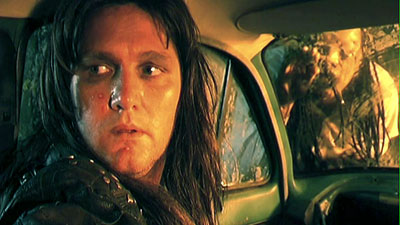
The
short film features three bogans (see below for an explanation
of the term) stuck in the inevitable Holden stationwagon
and surrounded by an unspecified number of cannibalistic
living dead. All but the final few moments of the film
take place inside the Holden, focused on the increasingly
wretched faces of its three somewhat dim inhabitants
as they struggle to work out what to do in order to
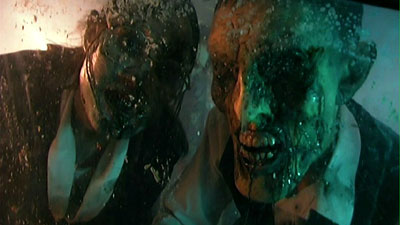
eat, piss and escape. Peripheral visions of zombies
shuffling around the windows looking for a way in and
a few excellently designed zombie faces leering through
the dirty glass give the film a tight claustrophobia
that plays effectively against the grim humour of the
bogans' plight.
Zombie
Movie is like one extended moment (it takes
place over several days) somewhere in the background
of Romero's living dead series. I can easily envisage
an anthology of such "moments",
featuring characters from different social and national
situations -- an interesting potential subgenre. But
Zombie Movie isn't simply a random
and unformed snippet. There is a unified plot development
here, one that leads the bogans to a suitably ironic
resolution of their various dilemmas.
With
a good script, effective characterisations, intelligent
pacing and terrific make-up effects (as one would expect
from ex-WETA alumni), Zombie Movie
well deserves its "Best Horror Comedy Short Film"
award from Screamfest LA and "Best Short Film"
award from the New York City Horror Film Festival.
If
you want to experience the love for yourself, you can
download Zombie Movie for free from
Asquith and Stenbeck's 2chums
website.
Note:
For those living outside Australia and New Zealand,
a "bogan" is a term referring to a certain
social stereotype -- lower-class, not-too-bright ...
a "trailer trash" analogue perhaps, though
without necessarily containing the same suggestion of
innate violence and moral looseness. The "type"
does imply a very definite clothes sense, vocabulary,
hairstyle, and musical taste. The characters in Zombie
Movie are classic examples.
1
December 2006
Return
to top |
| Venom
(US, 2005) -- dir. Jim Gillespie
It
may have a voodoo background and a well-designed rampaging
zombie (thanks to Patrick Tatopoulos), but Venom
is nevertheless a fairly straight-forward teen slasher
flick, 1980s style. According to producer Kevin Williamson
(who used a similar template and made something new
with it in Scream, thanks, one suspects, to
the directorial nous of Wes Craven), creating a new
slasher franchise ala Halloween was exactly
the film's reson d'étre. Well, it pretty
well succeeds in replicating the form and indeed in
manufacturing an effectively identifiable villain --
much good it will do the fortunes of Dimension Films,
I suspect, who clearly hoped to initiate a new cult
franchise. The utter, straight-down-the-line predictability
of it all is, in fact, Venom's biggest
problem.
To
be fair, it's not badly done. The Louisiana location
is atmospheric and though the voodoo mumbo-jumbo no
doubt bears roughly the same relationship to real voodoo
as Flash Gordon science does to quantum physics,
it nevertheless makes the thing seem momentarily imaginative.
The stars are young and attractive -- and mostly required
to undertake minimal character development throughout,
being there to die horribly. You'll find well-placed
shocks, lots of MA-rated gore (R in the States), and
a script that says little but allows the cast to engage
in a full-on body-count fandango. It works
on that level. So, well and good. The trouble is, once
you're past the surface glamour, there's not much going
on and what is going on is way too familiar to generate
much enthusiasm.
All
up, however, Venom is reasonably entertaining
on its own undemanding level. There are certainly worse
big-budget teen-oriented horror films out there, where
the presence of all those beautiful young stars actually
works against the plot, dumbing it down to the point
of farce (such as the remake of The Fog)
and where the horror is leached out through a desire
to keep the age entrance criteria as low as possible.
At least this one doesn't flinch from its brutality
and isn't annoying enough to keep you from engaging
with the action. It's just that Venom
would have been much more than halfway decent with an
injection of creative intelligence and less respect
afforded the slasher template itself.
26
November 2006
Return
to top |
| The
Black Room (US, 1935) -- dir. Roy William Neill
More
a gothic thriller than a horror film in the tradition
of Whale's Frankenstein (1931), The
Black Room is a superb showcase for horror
legend Boris Karloff. Here he plays twin brothers, one
of whom -- it has been prophesised -- is doomed to kill
the other in the so-called "black room" of
a feudal castle, thus bringing the dynasty that spawned
them to an end. Karloff's acting is both subtle and
commanding. As kindly brother Anton and evil brother
Gregor, he brings a respectively likeable benevolence
and dark, immoral malevolence to the screen -- and then
astonishes even more as he subtly portrays evil Gregor
pretending to be the "good" brother he has
killed. His eyes positively sizzle with insincerity
and malice, while finely controlled body language and
the tone of his delivery create an indefinable tension
that few could pull off as well.
The
script is more than adequate (with good dialogue and
a well-worked circular inevitability to the plot), the
cast excellent and the cinematography atmospheric. But
there is no doubt that it is Karloff who transforms
the film into more than the standard period drama it
would otherwise be.
26
November 2006
Return
to top |
| Dead
Girl Walking (Japan, 2004) aka Kaiki! Shinin
shôjo -- dir. Kôji Shiraishi
Made
as part of Hideshi Hino's Theater of Horror
(Hino Hideshi no za horâ: kaiki gekijô)
hexalogy, the 44-minute Dead Girl Walking
exists at one extreme edge of the genre, offering little
by way of mainstream commercial glamour to recommend
it to your average cinema-goer. This will be seen as
a good thing or a bad thing depending on your point-of-view.
Cheaply made, the film exudes an art-school sensibility,
coming across as metaphysical meditation rather than
as a story -- though certainly things happen, many of
them both outrageous and gruesome. Shot mainly in black-and-white
(to reflect the colourless world of death that the main
character inhabits), the film neither gives you rational
explanations nor expects you to ask for them. What happens
happens, and to appreciate the film, you have to start
from that premise. It is not about making sense at a
plot-level; it is about emotionally absorbing the metaphor
itself, even when the film cheekily embraces some rather
nauseating imagery.
The
scenario is simple. Schoolgirl Sayuri has a heart attack
while watering her favourite plant and wakes up to find
that she has not only been pronounced dead but now exists
in a state of slow decay that repulses her family and
inspires them to try getting rid of her for good. She
escapes, but with body parts dropping off she's a bit
like the classic zombie and not overly adroit. Abused
and put on display in a freak show for the amusement
of its black-suited patrons, Sayuri seems doomed to
suffer a lonely, pained journey to reach ultimate extinction.
Given the misery and rejection she suffers, it's amazing
then that her final resolve is to live -- which she
does in an unexpected way.
Based
on a story by infamous manga artist Hideshi Hino --
whose gruesome and confronting works also inspired the
controversial Guinea Pig films, two of which
he directed himself -- Dead Girl Walking
is a J-horror curiosity for those so inclined, being
hard to recommend to any but a hardcore horror audience.
Not that it isn't effective. Much of the imagery is
both iconically powerful and moving. But there is a
degree of schlocky pseudo-seriousness that needs to
be tolerated in order to embrace the experience -- and
it's not likely that everyone will find in themselves
the gumption to walk away from the film honestly claiming
that they've enjoyed its descent into bloody existential
misery.
26
November 2006
Return
to top |
| Next
of Kin (Aust, 1982) -- dir. Tony Williams
With
the atmosphere of a haunted house flick in its first
half and a gradual phase-shift into the world of giallo
(an approach that is obvious from the beginning, once
you realise what's going on), Next of Kin
is an involving horror thriller that mixes its influences
to good effect, even if the sudden violent extremes
of its ending feel a little contrived (in itself a giallo
trait).
The
film has an Australian character that mutes some of
its most blatant influences -- a layback dustiness that
gives its slasher climax a natural quality (though few
will fail to be reminded of Halloween, sans
hockey mask). Sure, its Australian ambiance comes from
the setting, which is unmistakably in "the Bush"
-- even if the house itself would not be out of place
in a British ghost movie -- but the peripheral characters
play their part in drawing out the Aussieness as well.
Not to mention the accents. (As an Australian myself
and hearing Australians speaking all the time without
noticing an accent, I find it rather odd that our peculiar
Australian speech patterns are so noticable in local
films of this vintage.) Despite
the Aussie overlay, however, the movie's stylish visual
imagery and the distinctive musical themes that accompany
moments of physical threat and psychological fracturing
help evoke the giallo of Bava and Argento.
Slowly
paced and atmospheric, with generally believable characters
(especially the old folk), Next of Kin
benefits from director Williams' deliberate control,
which generates a growing unease that keeps the viewer
on edge -- until it all explodes into blood, violence
and fire. With good camera work and effective acting
on the part of its leads, especially Jacki Kerin as
Linda -- newly returned to her childhood home after
the death of her mother and haunted by more than memories
of the past -- Next of Kin survives
comparison with many of its better-known giallo
progenitors, or at least the less classic of them.
18
November 2006
Return
to top |
| Mortuary
(US, 2006) -- dir. Tobe Hooper
It
has become something of a cliché to say so, but
"Master of Horror" Tobe Hooper's cinematic
output has been patchy for some time, with little of
overpowering significance offered by him since the early
heady days of The Texas Chainsaw Massacre and,
in a more mainstream vein, Poltergeist. Those
who, early in their career, produce a film so potent
that it affects its genre's future -- and changes the
way audiences view the possibilities of horror cinema
-- can be tragic figures, as it becomes hard for them
to ever meet their self-created expectations, no matter
how effective their next project might be.
Yet,
with cover art and an "R" rating that promises
more than the upgraded teen-horror that is too common
these days, Mortuary comes over as
a significant disappointment, even making allowances
for unfairly raised expectations. A zombie movie from
Hooper sounds intriguing enough. And the premise isn't
too bad, as stereotypical as it really is: a new emotionally
damaged mortician, along with her two children, moves
into the long-abandoned mortuary of a small, struggling
industrial township only to find that there is Something
hidden beneath the house that won't let the dead sleep
peacefully. With appealingly grotesque design work (despite
some unnecessary and less effective CGI), a terrific
setting and good use made of various industrial sights
and sounds --along with some decent undead mayhem --
Mortuary should be better than it is.
The result, however, is less than involving and is as
teen-oriented as horror movies come.
The
trouble is, the film feels compromised and schizophrenic.
I suspect that Hooper was going for the sort of retro-pulp
comedic horror thrills that work so well for the small-town
scifi flick Slither, for example. In that film
the humour grew out of the characterisation and added
to the horror. Here the humour plays against the more
visceral elements and the potentially serious undertones
that might have provided an emotional focus for the
plot. Whether the trouble lies in the script, the acting
or the direction is a moot point. The actors (especially
Denise Crosby as the new mortician, Leslie Doyle) seem
unable to modulate their performance smoothly between
serious and comic, and the result is alienating. Even
the "oddball" characterisation of some of
the more peripheral characters doesn't find its place,
becoming clichéd rather than disturbingly eccentric.
Yet
ultimately it is the emotional shallowness that weakens
the film most -- and allows its concentration on the
teenage "outsider" status of Doyle's son to
dominate. It becomes a "safe" adolescent adventure,
albeit one loaded with considerable gore. There is nothing
particularly hard-hitting here, despite the narrative's
willingness to kill off "sympathetic" characters.
The kids seem relatively unaffected by the deaths of
acquaintances, friends and parents, being too busy running,
hiding and acting like the Scooby gang to notice. In
fact, in the end not much of it matters. And that's
the real kicker.
Hooper
has tried this sort of comicbook, tongue-hovering-in-cheek
pulp stuff before -- for example in Lifeforce,
his Invaders from Mars remake and even Eaten
Alive, all more successfully in my opinion. But
here it simply didn't work for me. The film kept pushing
me away. Mortuary isn't a dead loss
and it certainly looks good. But it simply doesn't leave
me with anything that's likely to stick.
12
November 2006
Return
to top |
| The
Haunted Lantern (Japan, 1998) aka Otsuyu: Kaidan
botan-dôrô -- dir. Masaru Tsushima
The
traditional nature of this kaidan, or Japanese
ghost story, is underscored by the fact that it is based
on a tale by Encho Sanyutei (1839-1900) -- an author
and performer of the late Edo-early Meiji period. His
popular story "Botan Doro" has been the subject
of some 18 film adaptations, this one being the first
of the "modern" period. Sanyutei's story was
itself an adaptation of a traditional Chinese folktale
that has a long history of re-telling and performance,
especially in the form of kabuki theatre. It
entered Japanese culture in the 1600s and became one
of that country's most loved kaidan, fusing
romance, sexual politics and terror into an emotionally
potent drama.
This
1998 film has an inevitably old-fashioned air about
it, particularly in comparison to other contemporary
Japanese ghost stories, such as Ringu and Ju-On:
the Grudge. Yet there is also a modern
sensibility that comes through the approach taken by
director Tsushima -- which is bloody and forthright,
utilising an array of digital SFX to manifest its horrors.
Nevertheless, it is the traditional elements that give
the film its main appeal, especially as the SFX are
patchy in effect and often quaint rather than frightening.
Still,
there is an undeniable power to The Haunted
Lantern's tale of passion, betrayal and guilt.
As is often the case in such traditional stories, it
is not always easy for the audience to locate where
its sympathies should lie, as main protagonist Shin
Hagiwara (Gitan Otsuru) suffers the supernatural depredations
inflicted upon him as a result of karma he has created
for himself in a previous life. The female ghosts that
haunt him (Yuna Natsua and Junna Suzuki) are demonic
and romantic figures, traumatised by betrayal, yet themselves
haunted by their own tragic passions.
It
is the role of exorcist Hakuodo (Akaji Maro) -- with
his blank white eyes and text-based mode of supernatural
attack -- that gives the film's climax an ambiance suggestive
of the colourful SFX weirdness so familiar from Hong
Kong supernatural action thrillers.
11
November 2006
Return
to top |
| Tales
of Terror from Tokyo and All Over Japan: the Movie
(Japan, 2004) aka Kaidan Shin Mimibukuro: gekijô-ban
-- dir. Various
"The
Night Watchman" (Yoshida Akio), "Wisps of
Smoke" (Suzuki Kosuke), "Gloves" (Sasaki
Hirohisa), "The Weight" (Suzuki Kosuke),
"Full-Length Mirror" (Miyake Ryuta), "Line
of Sight" (Toyoshima Keisuke), "The Promise"
(Amemiya Keita) and "Hisao" (Hirano Toshikazu).
If
your view of what is scary in ghost stories relies on
the threat of bloody death and violence, then you can
safely bypass this movie-length anthology of short,
anecdotal films and go seek out the latest unsubtle
generic gorefest.
The
stories in this "Best of" collection taken
from a Japanese TV show of the same name deal with the
numinous rather than the forthright. Their strength
lies in each particular approach, an atmosphere of bizarre
creepiness and an abundance of startling imagery, rather
than in plot. Each story contains moments of spectral
manifestation, with little narrative development, served
up as a ghostly anecdote -- they are indeed supposed
to have been based on genuine reported events.
Though
some (such as "Gloves" where the meaning of
the phantom gloves that strangle the protagonist on
a nightly basis is the crux of the story, or "Line
of Sight" where a shy and awkward student accidentally
gains notoriety via a spooky image in the background
of a self-made video portrait) more obviously work toward
resolution via some revelation, others rely on a single
weird image ("The Weight"), on a spooky supernatural
situation ("The Night Watchman", "Full-length
Mirror") or on an exploration of a state of mind
("Hideo"). In the story that offers what is
possibly the creepiest ghost of the lot -- "The
Promise" -- a young man is allowed to house-sit
his uncle's luxury apartment on the proviso that he
always "answer when called". He doesn't know
what this means until he starts to hear his name spoken
by some disembodied voice -- and the voice is only assuaged
when he responds. Naturally we eventually find out what
happens when he upsets the owner of the voice -- a bizarre
female ghost whose appearance makes Sadako (of Ringu
fame) seem normal.
No
attempt is made to connect the eight stories, so as
a film Tales of Terror remains resolutely
a series of anecdotes, joined only by being ghost stories
of one kind or another. In style, mood and situation
they are all quite different, and they range in tone
from seriously threatening to humorous.
Information
on the background of the film can be found elsewhere
on this site. All in all, these eight choices live up
to their reputation as being the "Best" of
the short films made for the TV series. They are entertaining
and at least creepy -- and the show's technical edges
having been smoothed out they group together well as
an effective cinematic experience.
5
November 2006
Return
to top |
| Shallow
Ground (US, 2004) -- dir. Sheldon Wilson
Shallow
Ground is an engaging, if blood-soaked, horror
thriller that takes a slightly different approach to
the concept of the vengeful ghost. Set in a dying backwoods
community and focused on representatives of the local
sheriff's office as they pack up in preparation to depart
the area, it begins with the startling image of a naked
blood-soaked youth striding through the trees and into
the sheriff's office. The film then proceeds to unravel
the lives of the few locals that remain. Most of the
characters carry some degree of guilt, but the real
focus of spectral vengeance is a mysterious hooded figure
who has been torturing and killing assorted victims
for reasons that are only indirectly conveyed and never
very thoroughly. Perhaps, when the revelation finally
occurs, the identity of the killer comes as no great
surprise (given the small cast and the presence of Patty
McCormack, the original Bad Seed), but it hardly
matters -- the revelation isn't the point. It's getting
there that counts, and the process is handled with impressive
style and considerable intensity by director Wilson,
whose only previous effort was a non-supernatural cable
TV crime thriller called Night Class (2001).
The
blood-soaked youth (portrayed with a numinous abstraction
by Rocky Marquette) isn't the killer that he seems,
despite all that blood caked to his skin and dripping
continuously from him. Rather he is a physical manifestation
of the dead. Coming in contact with his blood (which
seems to have a life of its own) provokes visions of
the past, usually traumatic, which in turn lead the
protagonists to recall their own culpability and guide
them toward the killer -- and from there to an effectively
gruesome act of revenge.
Refreshingly
this independent production resists the Hollywood urge
to explain everything, instead implying much of the
back-story rather than spelling it out. It feels at
ease in leaving the supernatural logic to fend for itself.
Don't look for a primer woven into the dialogue; there's
no Wise Old Man Who Explains Everything here. Though
a less-than-careful viewing might leave you confident
that the scenario doesn't entirely make sense, in fact
it seems to me that it does -- with one or two possible,
though relatively minor, exceptions. (Even the rather
generic "shock" coda can be made to fit well
enough into the script's "mythology" if some
imagination is applied to it, though nothing by way
of "official" explanation is offered. Either
way, it packs a nice minor wallop as we depart Shallow
Ground's rather messy world.)
Also
intriguing is one brief scene that takes us away from
the more claustrophobic forest setting and suggests
that the "composite ghost" phenomenon might
have a wider, more apocalyptic dimension. This aspect
is never expanded upon except as it relates to one of
the protagonists, but it provides the film with an even
darker resonance than it already has.
At
any rate though Shallow Ground may
not be a perfect incarnation of the ideas it develops,
it is nevertheless an intriguing and effective independent
horror film that holds its own against the average mainstream
product. It is deserving of the Best Picture award it
received at the 2004 Dead by Dawn Film Festival.
5
November 2006
Return
to top |
| Cold
& Dark (UK, 2005) -- dir. Andrew Goth
A
stylised modern-Brit cop thriller that morphs somewhat
uncomfortably into gruesome supernatural horror, Cold
& Dark is a near-miss that is nevertheless
more interesting than not. The film works best when
its punchy pseudo-realistic approach reveals mere glimpses
of the unnatural possession that reanimates "the
Gov'nor", Mortimer Shade (Kevin Howarth), and concentrates
on the ethical and emotional dilemma into which his
increasingly violent behaviour plunges new acolyte-partner
John Dark (Luke Goss). The trouble is, bloody, headlong
action and director Goth's confusing approach to communicating
the story too easily overwhelm the real conflict lying
deeper in the narrative. And when the infecting "grail"
creature manifests itself by way of a grotesquely morphing
hand with a heavily fanged alien serpent erupting from
its palm -- like something straight out of a Stuart
Gordon film -- the styles fail to completely meld and
the viewer is all too likely to be thrown from the frame.
Yet despite this and the fact that an abundance of style
can't entirely hide the film's basically simplistic
narrative, Cold & Dark remains
admirable for its gritty, hard-nosed edginess and Goth's
obvious ambition.
5
November 2006
Return
to top |
| The
Thing (US-1982; dir. John Carpenter)
Some
films so etch themselves into your consciousness that
they affect the way you judge everything that follows.
For me, The Thing -- John Carpenter's
1982 version of John W. Campbell's story "Who Goes
There?" -- is such a film. Though an archetypal,
if exceptional, monster flick, it transcends mere "popcorn"
superficiality through its iconic power as an exploration
of paranoia, strongly evoking one of the central metaphors
of the horror genre: our sense that things aren't what
they seem. At the same time it is unremittingly frightening;
Carpenter's mastery at building and sustaining tension,
and choreographing scenes of unnatural terror, is at
its peak here. Hugely underrated at the time of its
release, The Thing just looks better
and better as the years go by -- its supposedly "outdated"
physical effects achieving a level of visceral impact
that CGI can't quite replicate. Time has also undermined
accusations that it is merely a gross-out extravaganza;
in fact, it doesn't look particularly gratuitous at
all in the light of subsequent developments -- though
the strong impact of its ghoulishly weird imagery remains.
Claustrophobic, muscular and beautifully paced, with
an ending that is so appropriate it's scary, it represents
a high point of modern horror cinema.
Comparisons
with the 1951 classic The Thing From Another World
are pointless, of course, if inevitable. Yet though
general critical wisdom is that the earlier film is
the best of the pair, for me Carpenter's "remake"
is the greater achievement: more gripping, more frightening
and, as an exercise in paranoia, more quintessential.
It is also, of course, a much more accurate rendering
of the original story.
Together
with Prince of Darkness and In
the Mouth of Madness, The Thing
forms what Carpenter refers to a his "Apocalypse
Trilogy".
24
October 2006
Return
to top |
| The
Diary of Ellen Rimbauer (US-2003) -- dir. Craig
R. Baxley
Though
it features characters created by Stephen King for his
mini-series Rose Red (including the titular
haunted house), this film can easily be enjoyed as a
separate entity. Its sense of period drama and a narrative
that concentrates on the married life of Ellen Rimbauer
and her relationship with the house that is re-constructed/built
for her, and then by her, give it a satisfactory completeness
that neither depends on a knowledge of Rose Red
nor on a need to reach some iconic pre-ordained moment
of revelation. Effective if somewhat stylised acting,
good cinematography and a slow-burning but compelling
build-up toward its admittedly inevitable climax make
this telly movie a worthy addition to cinematic ghost
lore. Those wanting all-out horror or unrelenting chills
will no doubt be disappointed, as the film relies more
on subtleties of atmosphere and character drama than
it does on moments of supernatural spectacle. But it
handles the dramatic needs of its traditional Anglo-influenced
haunting well -- obsession, betrayal and the claustrophobic
power of Place being the order of the day.
3
November 2006
Return
to top |
| Seven
Mummies (US-2006) -- dir. Nick Quested
A
motley group of escapees from a crashed prison van --
with their inevitably gorgeous prison-guard hostage
-- stumble upon the possibility of treasure in the middle
of the Arizona desert, thanks to the enigmatic cackling
of a old injun they meet along the way (whose melodramatic
laughing goes on for an annoyingly long time and even
gets a last-scene reprise). Unfortunately the treasure
is "guarded" by a ghost town full of refugees
from the Old West, not to mention the mummified, though
rather lively, remains of seven Jesuit priests. Our
protagonists try to find the gold and this causes much
mayhem, bloodshed and dusty mummy kung-fu fighting.
Western ghost story? Curse-of-the-mummy tale? Zombie
flick? Vampire thriller? The film could be any of these
things. That's not bad in itself -- in fact, it's potentially
good -- but the trouble is that no one, least of all
the scriptwriter, has managed to work out the logic
of the back story, the mythology involved or the central
narrative itself. Or if they did, it was somehow lost
in translation. Nothing comes together at all.
Seven
Mummies was an independent production with
an estimated budget of $5 million. Sometimes the impact
of those dollars is obvious enough. For example, the
cast is a potentially decent one that includes the rather
attractive Cerina Vincent in a pointless and illogically
developed role, the main purpose of which seems to be
for her to look sexy in her sweaty low-cut, non-standard,
prison-issue singlet top (even if all those horny, immoral
convicts she's with completely fail to notice this),
and the gaunt and scary-looking Billy Drago as the sheriff/lead
mummy. Other positives are the good make-up and (mostly)
effective gore effects, some OK music (even if it alternates
with some rather inappropriate music and is often poorly
synched with the dialogue and action), the convincingly
stereotypical Western township and some patchily expansive
use of the landscape in the first half.
But
the whole thing is so illogical, nonsensical and cinematographically
and narratively choppy that the effect of the good stuff
is lost well before the silly last moments of the film
are thrust upon us (violating, as they do, everything
that was established a few moments before). The film
is full of confusion -- and not the deliberate kind.
The characters do dumb things when they're not supposed
to be dumb, the violent and immoral convicts are illogically
selective in their immorality, nobody asks the obvious
questions (such as "Why is this town we've just
stumbled into full of refugees from old western movies?"),
important elements are introduced that lead nowhere
either emotionally or narratively (such as the purpose
of the seventh medallion, and the suggested romance
between the Gorgeous Prison Guard and the Only Nice
Convict), -- and, worst of all, the main impulse to
take the DVD off the shelf in the first place -- to
see the titular seven mummies in action -- remains largely
unsatisfied as they only turn up at the end and as far
as I could tell were nowhere near seven in number! Argghhh!
Whatever happened to truth in advertising? On top of
that, while the film starts well in terms of editing
and picture-quality, both these things deteriorate sharply
as it progresses -- suggesting that the makers ran out
of money or inspiration or lighting equipment or all
of the above. The frequent shadowy scenes become extremely
murky and appear to have been filmed using video, and
the editing becomes so haphazard it's sometimes hard
to tell what's going on.
In
short, whether inspired by Joe Lansdale's Dead in
the West stories, the western vampires of Near
Dark, Ossorio's Blind Dead zombies, or
Tarantino's crime-vampire crossover From Dusk to
Dawn, Seven Mummies doesn't succeed
in turning its positive assets into an effective horror
film, even one that might be embraced by a cult audience.
22
October 2006
Return
to top |
| Puppet
Master vs Demonic Toys (US-2004) -- dir. Ted
Nicolaou
André Toulon's ex-Nazi-fighting marionettes are
revivified in this continuation of the Puppet
Master series -- in order to take on, Jason
vs Freddy cross-franchise style, the titular characters
from the (admittedly fairly lame) Full Moon evil-doll
flick Demonic Toys.
Sounds OK if you're into evil puppets? The sad truth
is, though, the script is so bad and so lacking in any
real understanding of both genre necessities and the
Full Moon ethos itself, it's really hard to revive one's
past affection for the semi-heroic psychotic little
guys. Sadly, the puppets are given little to do, being
smothered by some indifferent human activity. Even when
they do get into a bit of biffo with the toys from Hell,
the result is so pitifully choreographed it doesn't
give the audience much to engage with. It should be
noted that though Charles Band receives an executive
producer credit, he apparently had nothing to do with
the film, the rights to both franchises having been
acquired by the SciFi Channel. So this time it's not
his fault.
But,
folks, where's the gore? Where's the gratuitous violence?
Where's the nudity? The film does make some pretense
of including these things (well, not the nudity), but
it's all too watered down and too awkward to keep any
sort of grip on the viewer's attention. Corey Feldman
overacts and engages in one-note comedic eccentricity
-- so that in the end his character is annoying rather
than endearing. The puppets do get a mecha upgrade,
but seem stiffer than they did in 1989 under the auspices
of then-animator Dave Allen, and their various psychotically
intense personalities have been leeched almost completely.
The plot is tired, the script ill-conceived, the direction
lazy and the narrative pacing (such as it is) completely
miscued. Even the odd decent concept (the demon's Speedy-Gonzales-like
movement, the sonic attack of the evil Jack-in-the-Box,
Six-Shooter with laser weapons) isn't enough to fire
the imagination for long. Oh, well. None of the Puppet
Master films were what you might call brilliant,
but they were generally fun. This one -- the ninth in
the series -- neglected to take account of that
tradition as well.
21
October 2006
Return
to top |
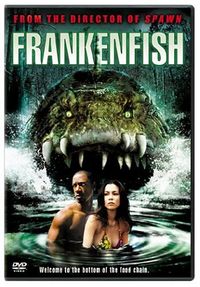
| Frankenfish
(US-2004) -- dir. Mark A.Z. Dippé
Don't
be confused by the title. Frankenfish
isn't about a revitalised monster-fish sewn together
from the parts of random fish corpses. The title refers
to recent media usage of the prefix "Franken-"
to designate genetic modification, as in "Frankenfood".
It isn't a Mary Shelley rip-off, though it certainly
works within a time-honoured cinematic sub-genre.
The
most original thing about this mutant-creature-on-the-loose
SciFi-Channel horror film, in fact, is the monster itself
-- a genetically modified Asian snakehead fish (the
real-world
progenitors of which are apparently known in the
vernacular as "Frankenfish") -- and even that
looks rather like a less convivial version of the coelacanth
that causes so much trouble in Jack Arnold's 1958 genetic-throwback
flick Monster on the Campus. Everything else
is fairly standard.
But
that's not to say it isn't effective. In fact this is
one of the most enjoyable modern B-film monster pictures
I've seen for a while, with effective and pacy direction
(by Spawn director Dippé)
and a decent if unadventurous script. What's more it
makes atypically savvy use of both physical and CGI
effects to create the monster and to give it its much-needed
ferocity. The film is gory, fast and knowing -- and
what it knows is that unoriginal B-films can work if
we care about the characters (even if they are stereotypes
such as "the Voodoo lady", "the local
boy made good", "the attractive marine biologist"),
the audience is kept slightly (but not too far) off-balance
and the film doesn't cheat them by failing to provide
decent build-up and some degree of climactic closure.
With
excellent bayou photography -- open and clear, especially
during the all-important night scenes, yet still able
to become claustrophobic when appropriate -- Frankenfish
looks more cinematically convincing than its origins
would promise and it maintains a tone that is nicely
modulated between non-condescending humour and full-on
suspense (in a way that reminds me of the superb 1990
monster flick Tremors -- even if that
film was more intelligently and tightly scripted and
its actors better known).
My
only significant gripe would be use of the "rich
hunter" trope -- you know, the one where the mutant
fish/snake/lizard/whatever has been created/stolen/paid
for/imported by some rich hunter because such prey has
never existed before and it gives him a sadistically
orgiastic thrill to be the one destined to hunt it down.
However, in Frankenfish this rather
tired and unconvincing cliché plays a relatively
minor role, so I can live with it. The effectiveness
of everything else balances it out.
In
short, then, if you like monster flicks, you probably
won't be disappointed with this one, even if it doesn't
end up on your top-ten best-of list.
14
October 2006
Return
to top |
| Black
Friday (US, 1940) -- dir. Arthur Lubin
It
would be wrong to blame Stanley Ridges for the relative
failure of this minor crime-noir scifi horror film.
Though hardly a genre luminary, especially in comparison
to Karloff and Lugosi, he does an admirable job in the
central role of kindly English Professor George Kingsley,
who suffers from a Jekyll-and-Hyde personality instability
thanks to the dubious, if life-saving, surgery of Dr
Ernest Sovac (Karloff). Using minimal make-up effects
(slicker hair and a certain hardness added to his face),
he manages to become a totally different personality
when the brain of violent criminal Red Cannon takes
over, displaying subtle (and unsubtle) changes in manner,
body language, tone of voice, general demeanour and,
well, moral ambiance. Ridges' acting is so effective
in fact that at times you start to wonder
if it's a different actor playing the role after all.
So
it is not Ridges' performance that is the problem, but
confusion in the production as it relates to the main
stars themselves -- a casting glitch that director Lubin
couldn't quite overcome. The key role of Dr Sovac was
clearly written for Lugosi (with that foreign name and
all), but Bela was relegated to a minor role as a gangster,
getting little screen time and none in the company of
his co-star. Karloff himself handles the role of the
well-intentioned but ethically compromised surgeon with
his usual panache and authority (a "mad scientist"
role he undertook many times during this period), despite
the fact that he was originally set to play the dual
role of professor and mind-subverting gangster. Whether
the decision not to do so was his own or the studio's
(some claim he couldn't convincingly handle the role,
though that doesn't seem likely as he had undertaken
similar character parts many times), the effect was
to cripple the film, fatally skewing its dynamics. With
Lugosi as the surgeon and Karloff as the professor/gangster
we might have had a classic.
While
the script itself (co-written by B-film veteran Curt
Siodmak, of The Wolf Man fame) seems somewhat
underdeveloped, it still has its moments. And the main
critical gripe directed at it -- the illogic of a "brain
transplant" leaving the patient with both sets
of memories -- is based on a misunderstanding. As is
made clear in Karloff's dialogue toward the end, what
was transplanted was not the entire brain but parts
of it; the doctor's experimental interest (as distinct
from his pursuit of funding) lies in proving that transplanted
brain cells can be made to integrate with the cells
of the patient while in fact retaining the memories
of their donor. Still bogus science no doubt, but at
least it makes some sort of Hollywood scifi-horror (non)sense.
As
it is, Black Friday is an entertaining,
fast-paced, if somewhat off-kilter film -- a better
crime-noir than horror flick. Its claim to being a Karloff/Lugosi
team-up feels like marketing deception and that puts
audiences off, dooming it to the status of a mere aberration
in the canon.
14
October 2006
Return
to top |
| Dracula
(US, 1973) -- dir. Dan Curtis
For
several decades, Dan Curtis (who passed away of a brain
tumor in March of 2006) lurked in the background of
horror film commentary, relegated to being something
of an outsider because he specialised in television
production. Most famous, perhaps, for his involvement
in the vampire melodrama series Dark Shadows
(1966-70, 1990-91), he was also responsible for many
horror films, including (as director) House of Dark
Shadows (1970), The Night Strangler (1973),
Scream of the Wolf (1974), Turn of the
Screw (1974), Trilogy of Terror (1975),
Burnt Offerings (1976), Intruders
(1992), Trilogy of Terror II (1996), and (as
producer) Dr Jekyll and Mr Hyde (1968), The
Night Stalker (1972), Frankenstein (1973)
and The Picture of Dorian Gray (1973). These
are the work of a man with a firm grasp on the aesthetics
of the horror film and the technicalities of evoking
an atmopshere of terror. And one of his most memorable
efforts was the tele-movie Dracula
(1973), starring Jack Palance as the Count.
This
version of the Bram Stoker novel is not only more faithful
to its source than most, but contains one of the best
portrayals of the vampire lord yet produced for the
screen. Bela Lugosi's Dracula might be the more recognisable
and the most iconic of them all, but Palance's Dracula
is frightening and imposing, and exudes a power that
few have captured on the screen before or since. He
is superb -- probably the first Dracula to encompass
such inhuman complexity, coming over as both fascinating
and unnerving. He is physically dominant throughout
and conveys a wonderful sense of dark power: aristocratic
without being effete; yet strangely, deeply haunted
by his lost humanity. What's more he looks like he might
have led armies -- and not gentlemanly armies, but armies
of semi-barbaric warriors. I loved the way Palance reacts
when Van Helsing (Nigel Davenport) thrusts the cross
at him; it hurts him and he must turn away, yet he fights
it with an almost despairing anger. The emotions --
loss, desire, hate, despair and animalistic rage --
swirl across Palance's features: confronting, yet not
melodramatic and overplayed. Palance has more than a
touch of Christopher Lee in his performance, but he
brings more complexity to its emotional nuancing than
Lee ever managed to give the role.
Coppola's Dracula takes much from this version,
too -- including the "lost love" storyline,
which Curtis (and Matheson) introduced as a way of giving
their Count a more emotionally potent rationale for
immigrating to England, while opening a door on his
lost humanity. Over all, in fact, the Richard Matheson
script is excellent -- inventive, yet closer to the
book than any that preceded it. Curtis' direction is
also inventive and wonderfully controlled, if somewhat
constrained by TV budgets and TV-style cinematography
(though he continually pushes the limits of standard
contemporary practice, creating effective camera movements
that cause the viewer to focus on important visual information
yet otherwise carry him/her effortlessly through the
narrative). Davenport as Van Helsing is not in Peter
Cushing's league, of course, but he is more than servicable,
and both Fiona Lewis as Lucy Westenra and Penelope Horner
as Mina Murray bring a convincing sensuality to their
roles as Dracula's less-than-unwillling victims.
But
it is Palance who gives the film its frisson.
His cry of suprahuman despair over the staking of his
long-lost love -- and the coldly inhuman revenge he
pursues in its aftermath -- stays with you long after
the film has ended.
10
September 2006
Return
to top |
Day
of the Dead 2: Contagium (US, 2005) -- dir.
Ana Clavell and James Glenn Dudelson
The
common assumption lying behind critical approaches to
this middle-tier zombie flick is that the decision to
identify it as a sequel to Romero's classic was an act
of exploitative insolence. But it may well be that its
creators conceived of the film as a genuine sequel/prequel,
displaying hubris perhaps, but a hubris that arises
from innocent respect for Romero and genuine enthusiasm
for the genre. For what it's worth, that's the impression
I get from both the film itself and interviews provided
on the DVD.
Nevertheless,
heralding Day of the Dead 2 as a sequel
to Romero's zombie classic was clearly a marketing misjudgement,
as the title alone has caused much derision among fans
and provoked avid condemnation from critics -- particularly
as there was no way it was ever going to achieve the
status of a "genuine" sequel. The title's
upfront pretension simply ensured that it wouldn't get
a fair hearing. At any rate I can only assume that the
negative expectations created by the title explain the
excessive scorn that has been heaped upon it.
So,
let's call it just "Contagium".
The
truth is, Contagium isn't all that
bad, and certainly doesn't show signs of being an ultra-cheap
knock-off, despite the limited resources on display.
This isn't Big Budget Hollywood of course, but it's
not sub-basement sheep-gut stew either. Though the film
has its flaws and displays occasional narrative miscalculation,
it isn't boring, cheapskate or laughable (well, not
in toto). The filmmakers were on a learning
curve, yes, and did not have full control over the film's
pacing and dramaturgical elements. But the technical
aspects are decently handled, the acting OK (in most
cases) and the gore plentiful. Overall it displays a
wealth of living-dead vim. The scenario even strives
for a touch of originality -- which is more than can
be said for many of the pseudo-Romero gorefests that
appeared in the 1980s in the aftermath of the Master's
success, or the standard Hollywood blockbuster for that
matter.
By
introducing an outer-space virus that causes rampant
genetic mutation, Contagium tries to
work a pseudo-scientific rationale for the zombie plague.
As a narrative device, the virus' non-sentient drive
to "create" a new race on Earth gives the
film character -- and very nearly makes sense, whatever
the scientific status of the jargon used to express
it. In particular the idea of a developing telepathic
connection between infectees is an intriguing one, though
in the end the concept is never fully developed. Contained
within a narrative structure that stretches back to
1968 (when Romero's plague first reared its cannibalistic
head), the film offers a new recurrence of the plague
decades later, garnished with a pinch of alien invasion
and a cornucopia of military overkill. The main narrative
isolates a number of emotionally crippled characters
within a psychiatric hospital setting, and that setting,
too -- with its One Flew Over the Cuckoo's Nest
ambiance -- speaks of something more than a careless
exploitative attitude. The thematic resonance provided
by characters striving to 're-make" themselves
psychologically and emotionally is effective in itself,
which only makes the inevitable tragedy all the more
ghastly.
In
the end Contagium can come over as
a decent zombie flick, should the viewer give it some
leeway. Romero it's not, nor is it in any way epoch-making,
but that doesn't mean it has no redeeming entertainment
value.
5
June 2006
Return
to top |
Hell
Night (US, 1981) -- dir. Tom DeSimone
Though
looking a tad staid, leisurely and even non-exploitative
by the frenetic standards of other 1980s slasher flicks,
not to mention more recent stalk-and-maim hits such
as Saw, Wolf Creek, Hostel
and the Hills Have Eyes remake, Hell
Night is surprisingly watchable due to its
darkly atmospheric build-up, good cinematography and
a few well-directed fright scenes. Often dismissed as
a sub-Halloween/slasher rip-off, the film actually
shares just as much with the haunted house tradition,
especially as there is a touch of ambiguity about the
status of gothic Garth Manor's mutant inhabitants, in
regards to their bloody history at any rate. Certainly
the killers' appearance and general air of supernatural
malice is monstrous rather than simply maniacal, with
nary a word spoken beyond a grunt, and considering the
sub-basement netherworld they seem to spring from. Ex-Exorcist
possessee Linda Blair brings a non-stereotypical air
of intelligent appeal to the central damsel-in-distress
role, at least until the story requires her to run around
screaming, and the ending is choreographed with enough
pizzazz to keep any halfway-tolerant viewer's eyes idly
glued to the screen. Though it has its fair share of
silly plot points and illogical conveniences, and is
saddled with the usual college-pledges-must-spend-the-night-in-haunted-house
motif, the film strolls, then suddenly speeds, to its
conclusion with more aplomb than might have been expected.
15
May 2006
Return
to top |
The
Tingler (US, 1959) -- dir. William Castle
After
the success of House on Haunted Hill and its
"Illusion-O" screen-defying flying skeleton,
B-horror film producer/director William Castle upped
the ante with his next film, The Tingler.
Once again, this one starred Vincent Price, who puts
in a totally convincing performance (handling some daft
dialogue with admirable aplomb) as Dr Warren Chapin,
a pathologist seeking to experimentally validate his
theory that fear gives life to an actual creature living
within each of us. According to his theory, the Tingler
grows along the spine when fed by our fear and would
break it, thus killing its victim, if the victim didn't
incapacitate the creature by screaming. It's a nice
idea and one that Castle develops only up to a point
-- but up to that point, he works it well. The first
two thirds of the film has an effective noir feel about
it, with its threats of murder, Chapin's femme fatale
wife and the marital contentions she provokes, and assorted
nefarious goings-on -- all with a SF/horror overlay.
For me, it's when the gimmickry kicks in that it all
goes to pieces.
The
basic narrative has a lot that is silly about it, but
Price and his fellow actors manage to blind the viewer
to the silliness for a while. There are even some excellent
scare moments, such as the hallucinatory sequence where
a deaf-and-dumb women is scared to death, culminating
in a bathtub full of lush red blood -- the only colour
in a black-and-white environment. To me, however, Castle's
fatal error is the very thing that makes his film such
a cult favourite: "Percepto", a bogus technique
that allows theatre patrons to directly experience an
attack by the Tingler. Everyone knows how it works;
random seats within selected theatres during the first
run were wired and set to vibrate at appropriate moments
during the showing. As Castle tells viewers in the film's
prologue, anyone experiencing a "tingle" should
scream as loudly as possible in order to avoid death
at the hands... um, feelers ... of the Tingler. I imagine
that the build-up and the participatory thrill of the
"event" worked brilliantly in 1959. Now, however,
despite its cultish interest as an artifact, the direct
inclusion of this piece of showmanship into the narrative
merely serves to truncate the suspense and to undermine
any imaginative involvement Castle has managed to generate
up to that point. As in 13
Ghosts, we are forcefully reminded that
what we're watching is driven by a gimmick; watching
it now, out of its time and on DVD, the film becomes
not so much a satisfying imaginative experience as a
historical curiosity.
Still,
up to that point, it works well and is great fun. The
central narrative concept still holds a lot of undeveloped
potential; perhaps one of these days someone will do
an effective, less-gimmicky remake. It's a pity Vincent
Price won't be able to participate.
9
May 2006
Return
to top |
Ghost Story
(US, 1981) -- dir. John Irvin
Fred
Astaire, Melvyn Douglas, Douglas Fairbanks Jr, John
Houseman: with a cast of nostalgic favourites like that,
Ghost Story promises to be an exceptional
entertainment. Certainly it's the sort of ghost film
that wants to be seen as more than a genre throwaway
-- an ambition it has in common with other horror films
of this period, such as The Exorcist and The
Changeling. To a degree it fulfils this
aim, with beautiful photography, an adult approach to
its subject matter (discounting the discordant presence
of too many shock-cuts of the ghost as a grotesquely
decayed corpse, courtesy of Dick Smith), and the evocative
central performance of Alice Krige as the decidedly
corporeal phantom. In the end, however, the film remains
too self-consciously portentous for its own good, with
flat direction that fails to realise the story's full
potential. Of necessity it simplifies the complex and
multi-layered novel by Peter Straub on which it is based,
substituting ageing regret and simple guilt for the
novel's atmosphere of cosmic damnation. That is fine,
but in the process there are redundant hangovers, such
as the role of Gregory and Fenny Bate, which simply
come over as meaningless and somewhat confusing. Nevertheless,
Ghost Story does succeed in effectively
capturing something of the core nature of the ghost
story: a tale of the guilty past returning to plague
the regretful present, told in a dark and claustrophobic
setting on a stormy night. Alice Krige's effectively
nuanced performance, along with the presence of the
old-timers, does carry the film over its low points,
so that it remains entertaining, if not as exceptional
as it was hoping to be.
19
March 2006
Return
to top |
Uncle
Sam
(US, 1997) -- dir. William Lustig; script by Larry Cohen
Larry
Cohen is not your typical Hollywood prodigy. Even a
casual glance at his best-known work gives a clear indication
of where he's coming from. As scriptwriter and director
(God Told Me To, It's Alive and sequels,
Q: the Winged Serpent, The Stuff,
The Ambulance) and as scriptwriter only (Maniac
Cop and sequels and the recent Phone Booth),
Cohen brings an inevitably low-budget, independent and
idiosyncratic sensibility to the exploitation film,
even in these times when exploitation can command huge
mainstream budgets. He knows his genre stuff and tends
to produce "cult classics" -- memorable films
that both celebrate and stretch their genre and that
retain an audience (albeit limited) well beyond their
brief theatrical life. Of course, the subversive mentality
he displays also means that audience reaction can be
divided and he is often dismissed as a hack. His attraction
to horror doesn't do anything to dispel this notion.
Cohen
wrote the horror B-film Uncle Sam in
collaboration with director William Lustig -- as they
have collaborated on other occasions, most obviously
on Maniac Cop; and the film certainly feels
like a Cohen production. Often comically brutal, it
is exploitative, low budget and genre-savvy -- and it
wears its left-wing, subversive themes with obvious
pride. Ostensibly a genre throwback to the "holiday/seasonal
slasher" films of the 1980s (with a zombie killer
returned from the dead to wreak havoc on the "guilty"
during 4th of July celebrations in a small town), Uncle
Sam works well both as entertaining low-budget
exploitation and as political satire. Beautifully shot
and generally well directed, it can be scary in the
cartoon-like, unrealistic manner of EC Comics and the
films that oeuvre inspired. The titular zombie even
looks like he's been directly transposed from Tales
From the Crypt. Sure, it lags in places and on
occasion its low budget is all too apparent. But as
well as excelling in the creation of the odd inventive
visual detail and some excellent horror sequences, where
Uncle Sam shines is in its surprisingly
intelligent questioning of patriotism, militarism and
political non-conformity, all encapsulated in a knowing
B-flick horror format.
Set
against the background of Kuwait and Desert Storm, Uncle
Sam presents us with a war hero killed by "friendly
fire", who rises from death as a maniacal zombie
and gives expression to his own less-than-heroic nature
in a bloody vendetta against anyone he sees as inimical
to the American ideal. To do so, he hides his disfigured
appearance under an Uncle Sam costume and mask. Despite
appearances and the film's obvious satirical intent,
however, Uncle Sam should not be seen
as a simple piss-take directed at the iconic Uncle Sam.
Its psycho war-hero is not the icon itself; he is a
brutal, twisted maniac who wears the mask of patriotism
as a means to indulge his own lust for brutality and
misdirected anger. The film carefully points out that
patriotism is not the same thing as blind, unreasoning
acceptance of the need to kill, that Uncle Sam is not
always right, not always what he appears to be, that
political "idealism" is not always "idealistic".
Blind opposition to the ideal is just as damaging as
blind acceptance of it: the maniac Uncle Sam kills both
left-wing and right-wing victims -- all "guilty"
in his eyes.
There
are few real heroes in Uncle Sam and
those that creep in are flawed and disillusioned. America
is under threat, not simply from external enemies, but
through the misuse of idealism for personal or simply
misguided ends. But is Uncle Sam the answer? As a hero,
the maniac Uncle Sam epitomises all that is bad about
war. Unfortunately the "ideal" of Uncle Sam
the icon is only an ideal; how it is manifested in reality
is another issue entirely, and too easily it can become
an evil in itself. The film creates a metaphor for the
proposition that we can't afford to mistake psychotic
brutality for necessary action. If we do, not just Uncle
Sam but democracy itself is likely to become a victim
of "friendly fire".
No
one is going to mistake the film Uncle Sam
for a classic of the cinema, but at its best it is an
intelligent "comic" horror flick that uses
its genre credentials effectively, exploring with a
wry smile a theme that is both important and timely.
At
the very least, on the other hand, it's all a bit of
a hoot. Dismissing it is easy for those so inclined.
But anyone willing to see both its genre awareness and
its complexities should embrace it with affection.
19
March 2006
Return
to top |
Death
Tunnel
(US, 2005) -- dir. Philip Adrian Booth
There
is a "revelation" scene in this haunted hospital
ghost flick at about the spot where you'd expect there
to be one. For the sake of those who have never seen
a ghost movie before I won't say what exactly is revealed,
but I will say that this climactic moment of enlightenment
is a perfect example of what is wrong with this movie.
The revelation should surprise no one -- unless they
really weren't paying attention. Apart from being an
oft-used cliché, it falls flat because the director
has already (albeit patchily) tossed most of the revealed
information at us, visually and verbally, several times
-- first on a totally redundant pre-title card, then
in a scene-setting medical lecture and then, ceaselessly,
in period flashbacks. So by the time the revelation
happens (and it is delivered as a revelation),
all the audience can do is frown and wonder what the
fuss is about and why the characters seem so surprised.
The fact that the revelation isn't overly original is
much less important than the fact that it doesn't come
over as a revelation at all. The backstory it represents
would have worked as an intriguing mystery if carefully
seeded into the narrative -- and it would have made
the movie a much more involving and suspenseful experience.
Giving
us too much, taking technique to excess, seems to be
this director's modus operandi. Though apparently
a low budget film, Death Tunnel looks
terrific; Booth has a firm grasp on the technicalities
of cinema and has produced a film full of impressive
style. Unfortunately the film has so much style that
atmosphere, suspense, character empathy, shock value
and narrative cohesion disappear in a nuclear flash
of distracting wizardry. What Booth doesn't seem to
realise is that too much style, ill-used, works against
the effect he is striving to achieve. Death
Tunnel offers, in abundance, slo-mo, flash
cuts, historical montage, subjective intercutting, fractured
motion, camera tilt and point-of-view shift. Often you
can't tell, on an immediate reactive level, whether
what is on screen is what the character is seeing or
what a different character, somewhere else, is seeing;
whether even non-ghostly moments are actually happening
or are meant to be impressionistic; whether an occurrence
is taking place now or happened long ago; or whether
an approaching shadow is in the same corridor as the
POV character or somewhere else entirely. Meanwhile
you are continually and fatally distracted by the sheer
sense of urgency. Nothing builds, nothing is coherent;
in the end, the overkill simply loses momentum and gets
dull. Even the superbly spooky real-world setting and
its potent history -- a now-abandoned hospital where
tens of thousands of "white plague" patients
were medically mistreated and met tragic ends -- is
rendered null-and-void by the visual frenzy of it all.
From the title sequence, the film screams out at you
that it is uniquely weird and utterly scary. The acting
continually insists that we are supposed to be feeling
more scared than we've ever felt before. The music shrieks
terror. The noise of all this cinematic protestation
is so loud we are simply numbed into a state of non-responsiveness.
I've rarely seen a clearer example of total disconnection
between cinematic style and narrative intent.
And
all this frenzy leaves aside the fact that the wonderful
setting is given a fictional treatment that you've seen
before many times and which was rarely convincing then:
the "initiation in a haunted house" scenario.
"Five floors, five girls, five hours ... five ghosts."
This is the 1981 pic Hell
Night on speed. Actually, the abandoned
hospital setting brings to mind the more recent film
Session 9 -- to the disadvantage of Death
Tunnel. Session 9 had style that was
used to create atmosphere, characters that were more
than attractive eye-candy, and a narrative that had
more than linear, if fractured, predictability.
20
February 2006
Return
to top |
In
the Mouth of Madness
(US, 1994) – dir. John Carpenter
Strange
how some films seem doomed to be underrated right from
the start. Third in what Carpenter refers to as his
"Apocalypse Trilogy" (the first two being
The Thing and Prince of Darkness),
In the Mouth of Madness is an effective exploration
of communal perception and its role in forming accepted
reality – and remains one of Carpenter’s
best and most disconcerting films. It is also one of
the best of the many films based on or inspired by the
Cthulhan imaginings of H.P. Lovecraft, with their vision
of vast inhuman "Old Ones" intent on re-gaining
command over the human world. Here, inter-dimensional
conquest takes place via a phenomenally popular pulp
horror novelist, whose works increasingly upset humanity’s
psychic (and physical) stability and offer up a fiction
that is designed to consume reality itself. Sam Neill
plays an insurance investigator who is rather smugly
adept at defusing the attempts of fraudsters to impose
their small, self-serving views of reality on insurers
and other financiers. "He’s an amateur,"
Neill’s John Trent says of one such fraudster,
and longs for the challenge of a true professional.
In the end he gets his wish, but to an apocalyptic extent
that totally overwhelms him ... and, given the ending,
us as well. If The Thing was a study
in claustrophobic paranoia, In the Mouth of
Madness is its agoraphobic twin.
9
January 2006
Return
to top |
Dead
Men Walk
(US, 1943) – dir. Sam Newfield
A
C-grade 1940s Dracula rip-off by any other name is still
a C-grade 1940s Dracula rip-off. In Dead Men
Walk, George Zucco gets to impersonate both
a Van Helsing-style doctor – initially skeptical
of supernatural possibilities – and his evil brother,
whose funeral begins the film and who soon, thanks to
his black-magic leanings, rises from the dead as a vampire-like
phantom. He gains immortality from the blood (aka the
souls) of his victims, leaving two puncture marks on
their necks, must hang out in his coffin during the
day, and is immune to bullets (but not crucifixes).
So, yes, he’s not the ghostly zombie promised
by the title but a vampire – and the basic story
is that of Stoker’s Dracula, as the undead
twin brother drinks nightly from the neck of the good
doctor’s niece and threatens to turn her, eventually,
into a vampire like himself. Meanwhile, we are offered
a variety of clichés to be going on with: the
initially skeptical fiancé, the helpless local
cop, the mad woman who knows the truth, the irate –
and skeptical – villagers, the hunchback acolyte
(played by an aging Renfield … um, Igor ….
no, sorry, Dwight Frye), a rampant mob seeking to deal
harshly with the good doctor under the belief that he
is the killer, and a climactic fire to reduce everything
to victorious, but tragic, ashes. "Bookending"
the film is the burning of a book on vampires.
Zucco
does well in his dual role, there never being much doubt
about which brother is which. But the production values
are not high, and the film is overall both predictable
and dramatically flat, despite the odd good image. There
is some camera tracking, but static theatrical cinematography
is much more typical. Generally the acting can be best
described as serviceable (I rather liked the violence-prone
leader of the rampant villagers and Frye is …
Frye), but nothing special. Still, if you don’t
mind watching a low-budget, seen-it-before variation
on Dracula, the whole thing isn’t
too bad (especially at just over an hour long).
9
January 2006
Return
to top |
The
Haunting of Lisa (Canada, 1996) – dir.
Don McBrearty
Presenting
us not with the ghost story promised by the title but
rather with a now familiar tale of psychic investigation,
The Haunting of Lisa suffers from its
mid-1990s TV-movie status, reflected not so much in
low-budget restraints (which can often be overcome by
good scripting and good performances, though such is
only marginally the case here), but in its bland lack
of visual style (stylised vision-sequences notwithstanding)
and an unconvincing plastic sheen given to both characters
and atmosphere. McBrearty’s direction simply fails
to transform the decent script into an emotion-charged
drama, always veering toward the static and bleeding
the characters of conviction. It proves hard to believe
in any of them as people rather than as actors, though
ex-Charlie’s Angel Cheryl Ladd performs well enough
as Ellen Downey. So does her on-screen daughter, Lisa
(Aemilia Robinson), whose innocent strength and vulnerability
provide focus to the tale of hereditary psychic powers
and ever-threatening killer. The script manages to bounce
viewer suspicions from one suspect to another with some
skill, and it is this that makes the film work to the
extent that it does. However, that extent doesn’t
take us very far. In the end the result is too undynamic
to warrant more than a cursory viewing. Comparison with
almost any episode of the similarly themed 2005 TV series
Medium will indicate why. In essence,
I think, The Haunting of Lisa is simply
too brightly lit, literally and metaphorically speaking,
to engage our imagination.
Though
I have no evidence of such being the case, The
Haunting of Lisa comes over as a pilot for
a proposed series, one that never eventuated -- not
unless Medium, with its “star”
female lead, its psychic crime-solving scenario, its
mother-and-young-blonde-daughter characters, and its
stylised vision sequences -- can be identified as some
sort of indirect, and vastly superior, descendent.
9
January 2006
Return
to top |
Riding
the Bullet (US, 2002) – dir. Mick Garris
Not
all horror films need to be, or should be, considered
"thrillers". Based on a story by Stephen King,
Riding the Bullet is more a meditation
on death than it is a standard horror film. Displaying
many of the narrative and thematic strengths and weaknesses
of latter-day King stories, the film uses horror elements
(the ghost/reaper, isolated hitch-hiker on a benighted
road, noises in the dark, strange deathly hallucinations,
redneck threat) to explore its main character’s
need to accept the inevitability of death and his own
responsibility to embrace life. Its production values
are high, with excellent cinematography and clear night-time
visuals; the acting is professional; the period setting
makes an effective background to the theme; and the
scenario works well, once you accept its literally linear
structure – in essence, with a few flashbacks,
protagonist Alan Parker (Jonathan Jackson) hitch-hiking
across the country to reach his hospitalised mother.
Mythically, the film depicts a journey through the death-realm
to reach moral and spiritual awareness – a classic
structure dating back to the beginnings of literature.
Here, the line between objective reality and subjective
experience remains blurred and uncertain, adding to
the metaphysical ambiance: Parker talks to himself,
literally; people and objects appear and disappearance
with the fluctuations of his grip on reality; we see
extrapolated possibilities (fears) directly dramatised.
Director Garris clearly delights in such audience manipulation,
and the technique does serve the theme. Over all, in
fact, Garris proves himself adept at capturing the mood,
nostalgic delight and hard-won sentimentalities of King’s
works – but if you are familiar with those works
you may feel that you have seen quite enough of such
sentiment already and that the serious side of King’s
reflections on mortality (which he does so well) can
too easily become a sort of self-created cliché.
9
January 2006
Return
to top |
Kill,
Baby, Kill!
[aka Operazione Paura] (Italy, 1966) – dir. Mario
Bava
One
of the most effective gothic ghost films of the 1960s,
Italian horror maestro Mario Bava’s Kill,
Baby, Kill still works for the darkly effective
beauty of its period settings and its rich colours,
its masterful pacing and direction, and its stylised
imagery of decay and haunted culpability. It well deserves
to be seen in the clear, uncut, widescreen image that
is now available on DVD; this format best serves its
romantic yet claustrophobic vistas, as Bava fills the
screen with a shifting panorama of twisted shadows,
garish pools of light and the overlapping textures of
broken walls, decayed wood, dead trees, obscuring mists,
dusty corridors and other metaphorical evidence of a
community in a state of moral ruin. From the moment
when summoned coroner Dr Eswai (Giacomo Rossi-Stuart)
arrives in the isolated village where the inhabitants
are dying mysteriously, he presents an obvious contrast
to what he finds there, in the immaculate stylishness
of his clothes and the civilised confidence of his manner.
Though both these things will suffer the depredations
of dealing with a force that transcends his medical
knowledge, his outsider status acts as a catalyst, initiating
events that may bring an end to the reign of fear and
vengeance that has blighted the town for over a decade.
Once again, Bava creates many superbly hallucinatory
sequences, as he explores the morally uncertain evil
that haunts the Transylvanian village. As well, his
depiction of “woman” is more complex here
than is often the case in horror films of this (or any)
period, as the numerous female characters adopt a variety
of roles: as the source of evil and its agent as well
as its victim and its nemesis. Eroticism, innocence,
maternal care and vengeance are incarnated in ways that
subtly manipulate the standard tropes of the genre and
give a unique power to the simple narrative.
Note:
One oft-used technique is that which heralds the presence
of the young girl haunting the town by the sudden appearance
of a ball that bounces across the visual field. An early
use of this particular image, it would appear often
in later ghost films, such as The
Changeling (1979), The Shining
(1980), the recent Feardotcom
(2004) and many others. Perhaps its suggestion of childhood
innocence, combined with the way a ball’s passage
can be marked by a combination of visually incongruous
movement and a regular thudding sound, is what makes
it so effective in the context of a spookshow.
9
January 2006
Return
to top |
|
|
copyright©Robert
Hood 2006 |
home
- the latest - new
projects - faq -
bio - biblio
- scribblings -
obsessions - links
Contact Robert Hood:  |
|
|